How Stream Handles Your Data: Trust by Architecture, Not by Promise
Every photo app asks for trust: trust that it won’t look at your photos, won’t train on them, won’t change the terms later.
Stream is built so that there is nothing to trust us with.
The Trust Problem
Uploading your library to a cloud platform means accepting promises you cannot verify — what happens on someone else’s servers is invisible to you, and policies, incentives, and ownership all change over time.
So the real question is not “is this company trustworthy?” but “why does this product need my trust at all?”
How Stream Handles Data
Stream is a management interface, not a storage service. There is no Stream cloud — all data flows between things you own:
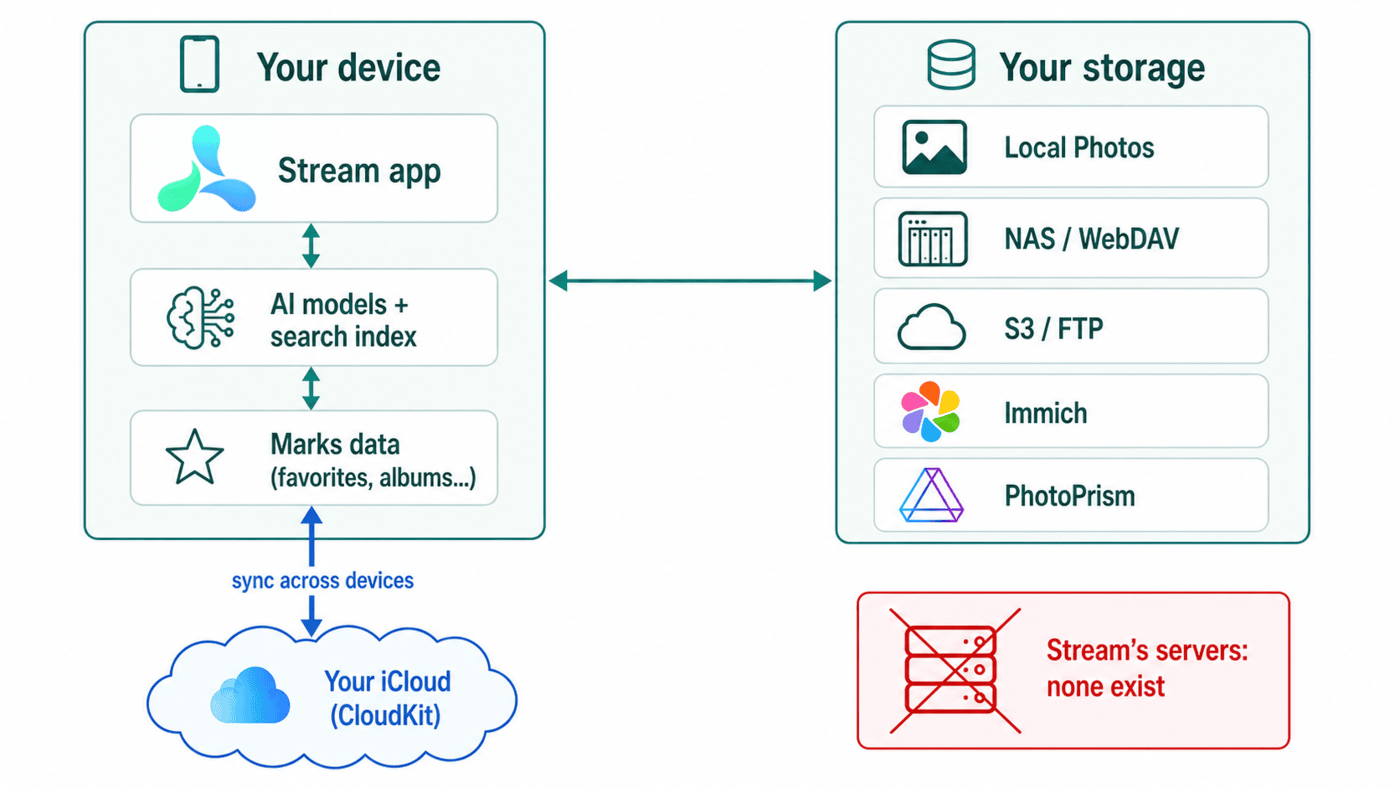
Three rules, one principle:
- Photos stay in your storage. Stream connects your device directly to your NAS, S3/FTP, Immich, or PhotoPrism. No server of ours sits in the data path.
- AI runs on your device. The image and text encoder models are downloaded to your phone; indexing and natural language search happen locally. A query like “a red umbrella by the sea” never leaves the device. The trade-off is honest: it costs your battery instead of a server farm.
- Organization data syncs through your account. Favorites, archives, and albums — User Marks Data — live on your device and sync via your iCloud. Stream has no account system collecting them.
What This Means in Practice
Because Stream holds no copy of your data:
- We cannot look at your photos — not “we choose not to”; the data is simply not on our side
- We cannot train on your data — there is nothing in our possession to train on
- A breach of our infrastructure cannot leak your library — there is no library to leak
- Leaving costs nothing — stop using Stream anytime; your photos stay in your storage, untouched
The honest cost: since we keep no server-side copy of your marks data, you should enable iCloud Sync or back up regularly.
Conclusion
Photos should belong to users, not cloud platforms. Data handling is where that philosophy becomes concrete — and verifiable: watch your own network and NAS logs; the design proves itself from your side.
A product that never holds your data never has to be trusted with it.